Featured

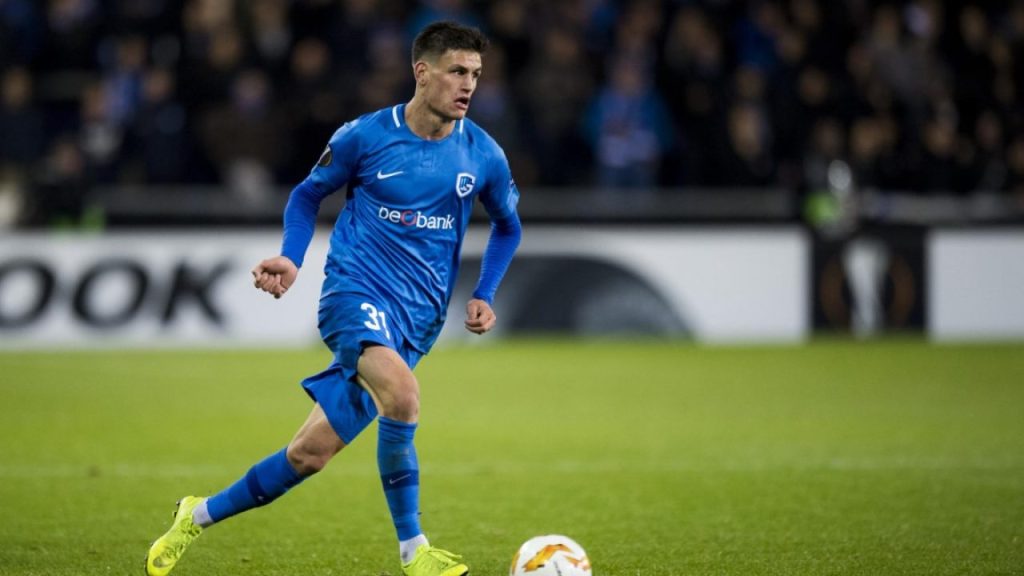
Joakim Mæhle

DOB: 20/5/1997 (22)

Nationality: Denmark

Club: KRC Genk

Tactical:

Mæhle is a very interesting player when it comes to his tactical attributes. In Genk’s system, he plays as a right-sided fullback in a four at the back system. However, he does like to get forward, and stay forward, making him susceptible on the counter attack. He also has the ability to play on either side of the defensive line, making him positionally flexible if there is an injury crisis or a change of system by Genk. He really likes to get involved in the build-up play on the right side of the field, with him constantly being in the opponent’s third and trying to drive to the byline with the ball. Sometimes he starts as a right or left sided midfielder, which I feel suits his play style more than being a traditional fullback. I feel that he would excel in a system that plays a three at the back where he could play a more advanced role and get more out of him tactically.

Technical:

When it comes to Mæhle’s technical attributes, he is a bit raw in certain things and excels in others. His passing ability is one of his strengths, with him completing over two-thirds of his passes attempted. Most of these passes occur higher up the pitch, when Genk get possession and push into the opposition’s third. He also is strong with the ball at his feet, and his dribbling ability is very good for a fullback of his stature. He frequently likes to take on defenders, and attempt to dribble past them. This dribbling ability was really put to show at the U-21 Euros with Denmark, where he dribbled past the defenders before playing a one-two with his teammate and then dinking it over the keeper. 

However, he is susceptible to getting caught ball watching, making it easy for players to get in behind him. He will sometimes tunnel onto the ball and stop paying attention to the other players around him, which makes teams like to attack down his side. Defensively, he is very raw. He does not win many of his aerial duels and does not win many of his tackles either. He seems to get bullied off the ball easily at times, but on his day, he could put in a very solid defensive showing.  With some more defensive coaching, he could become a very good fullback in both aspects of his game. 

Physical:

Physically, Mæhle stands at 6ft1 and has a lean body type. He does lack some pace as a fullback, with him not able to chase down the faster wingers in the Belgian Pro League once they get past him. His shielding on the ball is not the best, with him easily able to get bullied off the ball at times. Even though he has the advantage of being a taller fullback, he does not win many aerial duels, winning less than half of his duels attempted this season. When it comes to his physical attributes, he checks out better as being a wide midfielder in a three as opposed to staying as a traditional fullback in a four. 

Summary:

Joakim Mæhle is someone who is in an interesting place in his career. At only 22, he still has the ability to develop more as a defender and become a very good fullback. If he gets better defensively and stays as a fullback, he compares well to PSG’s Thomas Meunier. Like Mæhle, Muenier is a fullback who likes to get forward and be involved in the build-up play in the opponent’s third, but can also be susceptible defensively. However, Tuchel occasionally will line PSG up in a 3-4-3 with Meunier playing as a right sided midfielder, which puts Meunier in a position that plays to his stronger attributes. 

While Mæhle still has the ability to become like Meunier and get better at the defensive side of his game, I still feel that a change of position for Mæhle could help him play more to his strengths if he moved to a bigger side

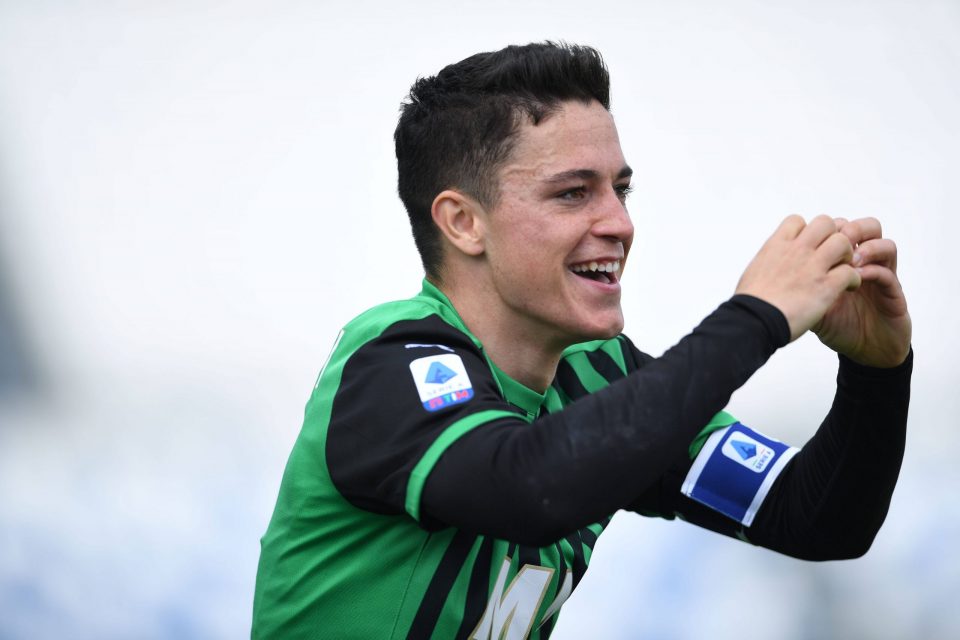
Giacomo Raspadori – scout report

Sassuolo's Giacomo Raspadori Could Become Transfer Target For Inter,  Italian Media Report

With Gianluca Scamacca currently out on loan, another young Italian striker has taken his chance with the Neroverdi, Giacomo Raspadori. Raspadori was born in the city of Bentivoglio, in the Emilia-Romagna region, not far from Sassuolo. He came through the Sassuolo youth academy, and made his senior debut for Sassuolo in 2019, and has gone on to make almost 40 appearances for them since. This scout report will look at and analyze Raspadori’s strengths and weaknesses, as well as his tactical fit in Roberto de Zerbi’s Sassuolo side. 

Tactical: 

In Roberto de Zerbi’s 4-2-3-1 system, Raspadori is deployed as the sole #9 in the system. With a recent injury to Francesco Caputo, Raspadori has mainly had to fight with Gregoire Defrel for the starting #9 position, and he has taken it and not looked back. Raspadori offers an interesting skill set to de Zerbi as the lone striker. Standing at only 5’8” he is not one to be a target man and win many aerial duels for his side. Rather, he offers more in the build-up play for his side. When Raspadori notices that space in the midfield opens up, he will drop into a deeper position in the midfield pockets and call for the ball to feet. Raspadori is very good at holding the ball up, and will receive the ball with his back to goal, allowing the time and space for teammates to make runs beyond him. 

Another strong suit of Raspadori is his ability to press in a high pressing system, something the de Zerbi implements at Sassuolo. When looking at the pressing statistics for Raspadori, you can see why de Zerbi has preferred him over the other striker options listed above. Compared against all forwards in Serie A this season, Raspadori ranks in the 74th percentile for pressures (17.14), the 93rd percentile for successful pressures (5.43), the 97th percentile for successful pressure % (31.7%), and in the 96th percentile for pressures in the attacking third (11.33). Giacomo Raspadori is a high work rate attacker, and would excel in any system that utilizes a high press. 

He also has very good positional awareness, and is adept at making runs in behind. While he does not always receive the ball when making a run in behind, his runs are able to drag defenders and occasionally midfielders, out of position, which allows his teammates to receive the ball in more advanced positions. Raspadori’s xGChain of 0.67 (league average of 0.49) also illustrates how much he is involved in Sassuolo’s build-up play, as he is not solely a striker who stays on the shoulder of the last defender to only make runs in behind. Tactically, Raspadori offers a lot in the build-up for this Sassuolo side, and it will be interesting to see how Scamacca and Raspadori possibly dovetail together next season when Scamacca returns from loan. 

Technical: 

From a technical viewpoint, Raspadori has his positives and his negatives. Being a #9, one of Raspadori’s main jobs is to put the ball in the back of the net. So far this season, Raspadori has scored 6 goals from an xG of 5.09, so he is currently just outperforming his xG. His G90 of 0.46 puts him in the 62nd percentile of all forwards in Serie A, so just above average. When it comes to his composure in front of goal, it could be worked on, as with any young forward, but his ability to not favor a certain foot helps in front of goal. Out of Raspadori’s six goals this season, three were from his right foot, two with his left foot, and one from his head. His shot accuracy of 80% this season also shows that he does not force many shots, rather, he gets himself into good positions inside the 18-yard box to take an accurate shot.  With this being Raspadori’s first full season as a senior player, he is outperforming expectations in front of goal, which bodes well for the future of the young Italian striker. 

Shot creation is another aspect of Raspadori’s game that he performs well in. When looking first at shot-creating actions, Raspadori ranks in the 90th percentile, with 4.21 shot-creating actions per 90 minutes. A shot-creating action is any action that leads to a shot, and can include dribbles, fouls, and passes. He does, however, rank lower in goal-creating actions. For this statistic, Raspadori ranks only in the 73rd percentile, with 0.54 goal-creating actions per 90 minutes. As mentioned earlier, Raspadori often finds himself in deeper positions in midfield, allowing him to pick the ball up in pockets of space before turning to find a teammate in behind. One stat that illustrates this contribution that Raspadori offers to the team is his through balls. Compared to all Serie A forwards this season, Raspadori ranks in the 96th percentile for through balls, with 0.38 completed through balls per 90. 

When it comes to dribbling, this is one aspect of Raspadori’s technical side that could be improved. While his close control can be good at times, and there are moments where he is able to turn into space with the ball at his feet, there are times where his dribbling leaves more to be desired, and an attack breaks down because he attempts to do too much. His 57.7% dribble success rate is not the worst for a striker, but definitely could improve as he starts to gain more experience of top flight football. The more striking issue comes with his control when the ball is at his feet. Raspadori averages 1.91 miscontrols per 90, putting him in the 84th percentile of all strikers in Serie A in that statistic. This is something that you commonly will see Raspadori do. Instead of finding an easy pass to a teammate to try and progress the ball further forward, Raspadori will try to slalom his way through multiple defenders, and as a result, either lose possession, or forget to bring the ball with him on some occasions. His first touch often lets him down as well, with good attacking chances going to waste because of this miscontrol. All in all, Raspadori has a lot of good things going for him technically, but as with most young strikers, has some things that he needs to work on as well. 

Physical: 

Being the type of striker that he is, Raspadori does not shy away from contact, but at the same time, he is not the best physically. This is illustrated by his duel success rate of only 45%, along with his aerial duel success rate of 30%. Being only 5’8” does limit Raspadori in the air, but he could very much improve on his normal duel success rate. From a defensive standpoint, Raspadori is not afraid to track back and help out defensively, and he will put a tackle in if it is needed. However, most of his defending is from the front, as shown by his tackles in each area of the field. Raspadori made 0.31 tackles per 90 in the attacking third, 0.15 in the middle third, and 0.09 in the defensive third. So, while he will track back and help defensively if needed, most of the time he will stay further advanced to be an outlet ball for a possible Sassuolo counter attack. A downside of his physicality in the attacking third is the amount of fouls that he commits. With 0.54 fouls committed per 90 minutes this season, Raspadori ranks in the 98th percentile for all Serie A forwards in this metric. 

Summary:

It will be interesting to see where Giacomo Raspadori’s path takes him next season. With Roberto de Zerbi supposedly leaving the club to take over Shakhtar Donetsk, a new manager may well be in place at the MAPEI Stadium next season. There is also the possibility of a bigger club taking a chance on Raspadori next summer, with clubs such as Inter Milan and AC Milan linked with the 21-year old Italian forward. However, the most interesting scenario is his possible partnership with fellow youngster Gianluca Scamacca once he returns from his loan at Genoa. It will be interesting to see whether the two strikers are able to play together, or whether Sassuolo may sell one to build around the other. One thing is for sure though, Giacomo Raspadori has a bright future, and is a name that people will be hearing for years to come.

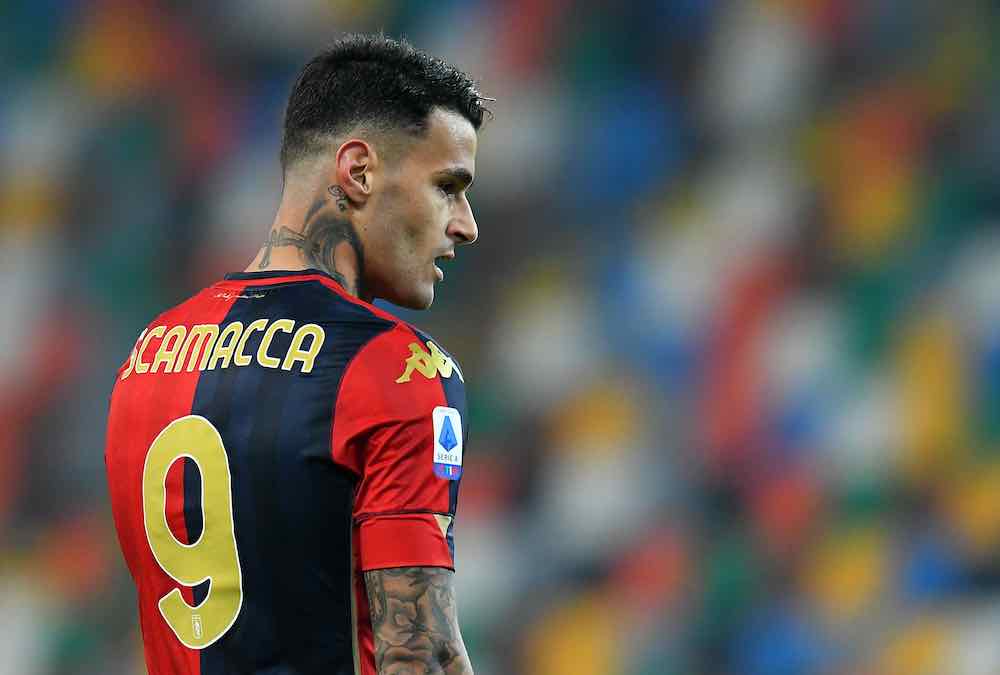
Gianluca Scamacca scout report – one of Italy’s best young strikers

Gianluca Scamacca: The New No.9 Making Waves in Serie A

Gianluca Scamacca is one of Italy’s brightest young striker prospects, excelling consistently for his country with the U-21’s, but has not been able to consistently find the same level of success at club level. Born in the Italian capital, Scamacca played at youth level for both sides of the Derby della Capitale (Lazio and Roma), before moving to the Netherlands with PSV Eindhoven. Scamacca made zero appearances for the senior team, instead featuring for Jong PSV. After a few seasons in Eindhoven, Scamacca returned to Italy with Sassuolo, but so far, he hasn’t been able to force his way through to the starting 11. Since joining, subsequent loan spells at Cremonese, PEC Zwolle, and Ascoli have followed, before joining Genoa this season, where he has started to find more consistent game time. This following scout report will analyze where Scamacca excels, and what he needs to work on to become a consistent regular for a club, whether that be Sassuolo, or elsewhere. 

Tactical

For Genoa, Scamacca plays as one of the two strikers in Davide Ballardini’s 3-5-2 system. However, Scamacca has not been able to become a regular starter for Il Grifone, with the likes of Goran Pandev, Mattia Destro, Eldor Shomurodov, and even Marko Pjaca getting the nod ahead of him up top. With that being said, Scamacca is almost always able to make an impact off the bench when brought on by Ballardini. His movement, as well as his physical presence (discussed later), allow him to bring a change of pace to the Genoa attack. With Genoa not being a high pressing side, Scamacca does not often press the central defenders when they are in possession, however, he will move to cut off passing lanes between defense and midfield, as well as between the two CB’s to force the ball forward if needed. 

When it comes to Scamacca’s positional awareness, he does well to scan the field and look for space in behind to run into, as well as looking over his shoulder for the positions of the opposition defenders before asking for the ball at his feet. He does have a good work rate defensively, and will track back to help out in the defensive third of the pitch if he senses that his teammates need assistance. A downside though is his tendency to occasionally switch off while in a defensive phase, with you sometimes being able to hear Ballardini screaming his name for him to get back into his position or close down the opposition player in possession. 

Technical 

When it comes to Scamacca’s technical qualities and playing with the ball at his feet, he can be a mixed bag. Though he is able to score goals from basically anywhere inside 30 yards, illustrated by Genoa’s match against Parma, his shot selection can be vastly improved upon. As the metrics show, Scamacca has an xG90 of 0.37, which is above the league average of 0.34. The problem arises when looking at Scamacca’s Sh90 of 3.28, which is well above the league average of 2.46. A lot of times when watching Scamacca play, he will attempt to shoot from almost impossible angles, or just be poor in general with his shot selection. If Scamacca is able to become more clinical with his shots, he has the potential to be a 20+ goal a season striker. 

His passing ability is another attribute where he can sometimes be a mixed bag. Though Scamacca has a KP90 of 1.38, well above the league average of 1.17, his pass accuracy in general is 66%, the second worst in Serie A in regards to outfield players. A lot of this can be owed however to Scamacca’s play style in general. Whenever Genoa are in possession of the ball and building the play up from the back, Scamacca does not play a large role. This is illustrated in his xGBuildup90 of only 0.10. This can also be witnessed when watching Scamacca play, with him tending to stay furthest forward on the shoulders of the last defenders. This is to allow him to get into the box quickly if one of the wide players plays a first-time cross in behind the defensive line. 

When it comes to Scamacca’s dribbling ability, he does not attempt to dribble past defenders or get into 1v1 situations often. With only 12 successful dribbles this season, Scamacca is much more of a target man striker, which will be covered in more detail next. He is not necessarily quick with the ball at his feet, but will attempt to dribble past defenders if he feels that the opportunity is there. 

Physical 

The physical aspect of Scamacca’s game is where he excels the most. He has tremendous aerial presence, and is not afraid to go shoulder to shoulder with any defender in Serie A. Being 6’5” means that dominance in the air should come as second nature. For the most part, this is correct. When compared to his other Genoa teammates, Scamacca has won 1.8 aerial per 90 this season, putting him second in this category behind only Cristian Zapata. Also, with a success rate of 58% aerially, he is able to win the majority of first balls that come towards him when in the air. The vast majority of the time, Genoa’s goalkeeper, Mattia Perin, will play the ball long. Whenever Scamacca is on the pitch, this long ball is normally targeted for him, with him winning the first ball the majority of the time. However, even with this aerial presence, Scamacca has not scored a single headed goal in Serie A this season, something that he needs to work more on if he were to become a more complete striker. 

Scamacca is also not afraid to go shoulder to shoulder with defenders, though his success rate in ground duels is not nearly as good as it is aerially, with Scamacca only winning 48% of his ground duels attempted. However, physically, Scamacca is one of the brightest young strikers, and if the rest of his game can become more rounded, then he has the potential to be one of the best young Italian strikers of this generation. 

Summary

As just noted, Gianluca Scamacca is one of Italy’s best young striking prospects, and if he can improve his game in certain places, then the sky’s the limit for the young striker. Most of these small issues as well for Scamacca can be fixed with more game time, something that he has not been able to get much of consistently at club level. Finally, at Genoa, Scamacca has been able to find his feet and play more regularly, and when his loan spell ends and he goes back to Sassuolo, they will have a tough decision on their hands about what to do with their bright young striker.

Rodrigo de Paul: Scout Report and Possible Landing Spots

Leeds in talks to sign £27m De Paul from Udinese | Goal.com

Rodrigo de Paul has become a wanted man. The 26-year old Argentine midfielder has been at the heart of Udinese’s midfield since 2016, and during that time, has become one of the most consistent midfielders in Serie A, with his recent performances linking him with a move away from I Friulani and to one of Europe’s elite. This following piece will feature a small scout report on the Udinese captain, as well as look at the possible clubs that could go in for him this summer if he chooses to leave Udine. 

Rodrigo de Paul: A small scout report

In Luca Gotti’s 3-5-2 formation, de Paul plays in the center of the three midfielders, where he is able to dictate play going forward, while also putting in a defensive shift as well. By definition, de Paul is a true box to box midfielder, with his outstanding work rate allowing him to consistently put in a 90-minute shift for I Friulani. 

Going forward, de Paul is the player that Udinese entrust to their chance creation as well as progressing the ball up the pitch. According to one-versus-one.com, de Paul ranks 1st in Serie A in key passes (28), key passes outside the box (23), chance creation (34), passes into the box (10), and xA (0.62). He also ranks 2nd in Serie A in passes into the final third (40), and pass progression value, while also ranking in the top 10 for passes in total. So far this season, de Paul has attempted 1,233 passes in total, with a staggering 80% success rate. As the stats above show as well, these are not all sideways or backwards passes, they are passes to progress Udinese into attacking positions, something that de Paul is key to. Add in his 5 assists and 79 touches/90, and Rodrigo de Paul is a midfielder who excels with the ball at his feet. With 5 goals as well this season, de Paul is also a player who has the potential to consistently score as well as create, making him a complete midfielder going forward. 

Defensively, de Paul is good, but not great. He does not attempt many tackles (29), but he has won 62% of those attempted tackles. He does however, excel in ground duels, with him winning 60% of the 346 that he has attempted this season. While good in duels on the ground, the same cannot be said about his aerial presence, with de Paul only winning 33% of his aerial duels attempted. With him standing at 5’11”, he should be able to have a bit more aerial presence, something that he could work on refining in the future. All in all, de Paul is a very competent midfielder defensively, and his well-rounded attributes make him a great fit for any side lacking a good box to box midfielder. 

When it comes to de Paul’s mental qualities, not much stands out to me that would be concerning for a future club. He is disciplined on the pitch with only 2 yellow cards this season (both ironically coming in the same match), and is a genuine leader as well for this Udinese side. He can always be seen shouting at teammates and pointing where he wants passes to be played, and is constantly asking his side for more. It can be easily seen why he was given the captaincy for the Udine based side. The next question to be answered then is, where would de Paul fit best if he were to move clubs? This next section answers that very question. 

Rodrigo de Paul: Possible club options 

Realistic option: Leeds United

Rodrigo de Paul was linked heavily with Leeds United last summer, and there would be no reason not to assume why Marcelo Bielsa would not go back in for his fellow countryman this summer. Looking at the physical, and more closely, the technical attributes of de Paul, and you can see why Bielsa was so determined to bring him to Elland Road last summer. Rodrigo de Paul fits Bielsa’s style perfectly, a tremendous work rate midfielder who excels going forward and tracking back defensively. In Bielsa’s usual 4-1-4-1 formation, the two central attacking midfield spots are occupied by Mateusz Klich and one of either Stuart Dallas or Tyler Roberts while Kalvin Phillips sits as a 6 to protect the back four. Klich has been a standout performer for Leeds this season, and being able to possibly put de Paul next to him could potentially take Leeds to the next level. Comparing the metrics for these players tells a similar story. Compared to Dallas, de Paul has performed better than Dallas in every metric except G90 and xGBuildup90, with both players having 0.20 and 0.32 respectively. Key passes per 90 has the biggest difference, with de Paul’s 2.30 KP90 shattering Dallas’s KP90 of 0.80. With Tyler Roberts, albeit on a very small sample size, he is outperforming de Paul on A90 (0.28 compared to 0.20), while being closer on KP90 (1.40 compared to Dallas’s 0.80.) 

This is nothing against both Dallas and Roberts, but de Paul has the potential to propel Leeds into challenging for European football next season. The only question that would present itself is would de Paul leave a consistent mid table side in Udinese to go to another potential consistent mid table side in Leeds United.

Intriguing Option: Liverpool 

The case for Liverpool being in the running for Rodrigo de Paul is a rather interesting one, but can be understandable. Georginio Wijnaldum is out of contract at the Premier League champions in the summer, and signs are pointing to him leaving the club this summer, with Barcelona heavily linked. Looking at Liverpool’s squad on paper makes it hard to imagine why they would pursue a deal for de Paul, with Curtis Jones, Fabinho, Naby Keita, Jordan Henderson, and Thiago all midfield options for the Merseyside club. Digging deeper tells a different story. Jürgen Klopp has normally lined Liverpool up in a 4-3-3 formation, with constant rotation normally occurring between the three midfielders. Injuries at center back has also forced Klopp to be more creative, at times starting Henderson and Fabinho at center half. Curtis Jones is still young and developing, and Naby Keita can’t seem to get a game. 

If Wijnaldum were to leave the club in the summer, replacing him with Rodrigo de Paul could be a great option for Klopp if he were to dip into the transfer market. Comparing the metrics for de Paul and Wijnaldum shows that de Paul would very much be a viable replacement for the Dutchman. However, comparing de Paul to Curtis Jones shows that the young Liverpool born player could be the one to step in the boots possibly left behind by Wijnaldum. Jones is outperforming de Paul this season in xGBuildup90 (0.38 compared to 0.32), while having the same xGChain90 (0.56). While he is not as good in the other attacking metrics, being 6 years younger than de Paul means Jones has more room to grow, and it would not surprise me if Curtis Jones is given the position possibly left behind by Georginio Wijnaldum if he departs for free this summer and Klopp decides to stick with the options that he has currently at the club. 

Best option: Inter Milan 

How about staying in Italy and joining possible soon to be Scudetto winners Inter Milan? Inter have been linked with de Paul recently, and it makes total sense why Antonio Conte would want to bring de Paul to the San Siro. First off, Conte operates the same system that Gotti operates at Udinese, a 3-5-2. This would allow Conte to get the best out of de Paul, while also still improving his squad. Currently, Marcelo Brozović and Nicolo Barella are nailed down starters in central midfield for Conte. This would mean de Paul would have to compete with either Christian Eriksen or Arturo Vidal for the final central midfield spot, so let us take a look at the metrics for the three players. 

While comparing de Paul to Christian Eriksen, what stood out most was KP90. So far this season, Eriksen is outperforming de Paul in this stat (2.33 compared to 2.30). Granted it is a much smaller sample size, but it shows that impact Eriksen has had since being restored to the starting 11 by Conte. He also does not trail de Paul much in xA90 (0.24 compared to 0.36), but would still be an upgrade, as Eriksen has not yet consistently shown that he is a surefire starter under Conte at Inter. 

When looking at Vidal’s metrics compared to de Paul, the first thing that stands out is that Vidal does not create nearly as many chances for his teammates as de Paul. However, Vidal does outperform de Paul in xG90 (0.22 compared to 0.18), but does not have a similar metric for G90 (0.08 compared to 0.20).  What this means is that de Paul is more likely to convert goal scoring chances that he should. With Vidal 33 years old, time is not on his side, whereas at 26, de Paul is coming into the prime years of his career. 

While Christian Eriksen is starting to find form and starting regularly in that final central midfield role, before, Conte could not find the right balance in that position. If de Paul came into the club and Conte polished up a few parts of his game, then Inter Milan’s potential midfield three of Brozović, Barella, and de Paul could become one of the best in world football. 

Conclusion:

To wrap up, all three of Leeds United, Liverpool, and Inter Milan should be considered options if Rodrigo de Paul decides to move this summer. While each club has its positives and negatives, I just feel that Inter Milan would be the best place for Rodrigo de Paul to take his football to the next level. 

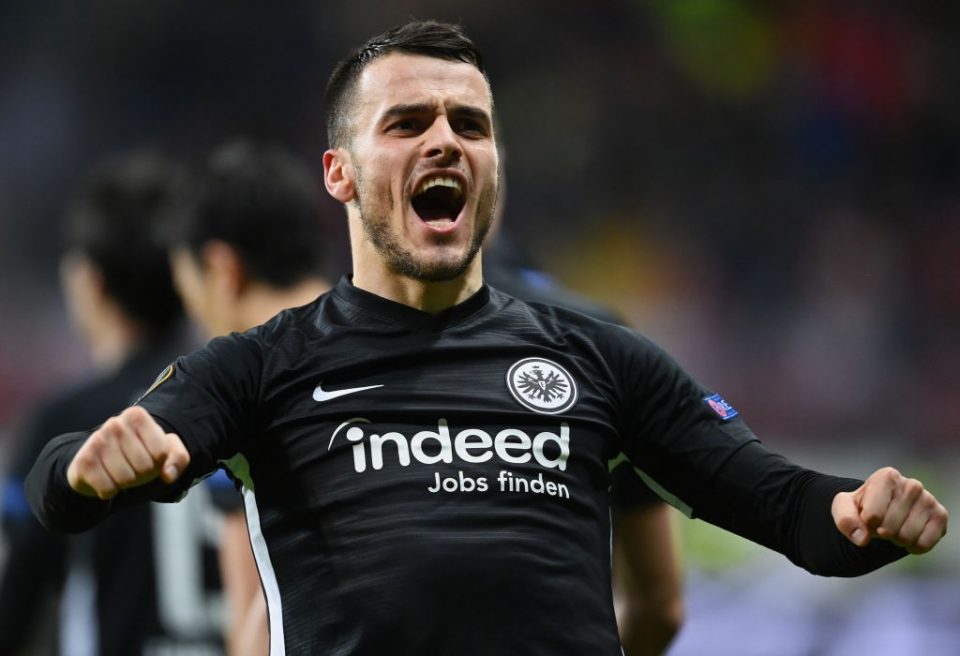
Filip Kostić data analysis: Why hasn’t a big money move arisen yet?

German Broadcaster Claims Inter Reignite Interest In Eintracht Frankfurt's Filip  Kostic

When Eintracht Frankfurt made it all the way to the Europa League semi-finals two seasons ago before being knocked out by Chelsea, Adi Hütter’s side were one of the best attacking sides in Europe. Sébastien Haller, Luka Jović and Filip Kostić were a formidable trio that helped propel Die Adler to the cusp of a European final for the first time since the 1979-80 season when they won the old UEFA Cup. After that season concluded, both Haller and Jović get the big money moves that were expected, Haller went to West Ham United for a fee that could rise to £45 million while Jović moved to Spanish giants Real Madrid for a fee of €60 million. Meanwhile, no move arose for Kostić that summer, and since then, there have been very minimal rumors linking the Serb with a move away from the Deutsche Bank Park. This data analysis piece will dive into the possible reasons behind this, and also what clubs make sense for Kostić if he were to move. 

The numbers 

Since moving to Eintracht Frankfurt from Hamburger SV in 2018, Kostić has been a familiar presence down the left-hand side in Adi Hütter’s 3-4-2-1 formation. Under Markus Gisdol at Hamburg during the 2017/18 Bundesliga season, Kostić normally played as the left attacking midfielder in a 4-2-3-1 system.

Kostić finished that season with 5 goals and 1 assist, while taking 2.46 shots per 90, and contributing only 1.12 key passes per 90. He also underperformed both his xG and xA that season, but that could be put down to different reasons. He also had an xG per 90 of 0.32, and an xA per 90 of 0.12. 

In his first season at Frankfurt, Kostić finished the season with one more goal scored than the prior season, but also contributed 9 more assists. His shots per 90 dropped drastically from 2.46 to 1.85 shots per 90, which shows that he improved his shot selection. His key passes per 90 also shot up to 1.40, with his xA per 90 also skyrocketing from 0.12 to 0.32. And since that first season in Frankfurt, his contribution has continued to grow. His xA numbers have slowly continued to rise, making him one of the most proficient chance creators in the Bundesliga. While the goal numbers have dropped this season, everything else has steadily increased. He already has 10 assists through about half the Bundesliga season so far, 1 shy of his total tally from last season. Also, according to one-versus-one.com, Kostić also ranks in the top three in the Bundesliga for assists, key passes, chance creation, and expected assists All these numbers show that Kostić is a consistent performer, so why has he not yet secured that big money move away from the club like the others before him? There is one reason as to why a move may not as of yet, materialized. 

The grass isn’t always greener on the other side

As the old saying goes, “the grass isn’t always greener on the other side.” After both Haller and Jović both completed their big money moves to West Ham and Real Madrid respectively, expectations were placed upon them to become instant successes. Almost two seasons on from their big money moves, both players no longer play (in Jović’s case, temporarily) for the clubs that signed them permanently for those fees. After 1 ½ seasons in the Premier League, Haller was sold to Ajax this past January for €22.5 million, with West Ham taking a major loss on their investment. Jović has had an even worse time at Madrid, first with playing time hard to come by behind Karim Benzema, and second, not performing when called upon. Jović returned to Frankfurt on loan in January, and scored the same amount of goals in 25 minutes than he did in 1 ½ seasons in the Spanish capital. Taking a deeper look at their numbers since departing tells part of the story. 

Both players took a heavy drop in production after leaving the German side, with the xG per 90 of both players dropping, as well as their G+A numbers, with both players losing a large percentage of their production. In his two seasons in Germany, Haller was involved in a goal every 122 minutes, whereas at West Ham that number plummeted to a goal or assist every 289 minutes. For Jović, he averaged a goal or assist every 103 minutes, while at Madrid he has averaged a goal or an assist every 185 minutes. Now, since returning to Frankfurt, he has averaged a goal or assist every 78 minutes. Now I am not saying that both Haller and Jović are products of the system put in place by Adi Hütter, but that the system Hütter has in place got the best out of them. In regards to Kostić, it’s possible this could also be the case. 

So, which clubs should look to sign him? 

In this section, I will look at four different clubs that should have an interest in signing Kostić in the summer. I will list a realistic option, intriguing option, outside the box option, and the best option in my opinion. So, without further ado… 

Realistic option: Borussia Mönchengladbach

 With Marco Rose set to leave the German club at the end of the season for rivals Borussia Dortmund, Mönchengladbach are on the hunt for a new manager for next season and beyond. One name who has been heavily linked with the German side is Frankfurt boss Adi Hütter. If Hütter were to get the job at Borussia Park, there would be no reason not to assume why Kostić could possibly follow him an hour and a half west to Gladbach. When a new manager comes into a football club, tactics and formations usually change, along with plenty of new faces coming in over time. If Hütter were to come in at Gladbach, Kostić should be the first player he looks to poach from his former club. 

Marco Rose has recently tried implementing a back three system at Gladbach, with him alternating between veteran Swede Oscar Wendt and young Austrian Valentino Lazaro at left midfielder. Between the two of them combined, they have key passes per 90 of 1.17 (0.43 for Wendt, 0.74 for Lazaro), while this season alone, Kostić has 2.68 key passes per 90. For xA per 90, Wendt and Lazaro combine for a measly 0.09 xA per 90 (Wendt = 0.04, Lazaro = 0.05). Kostić meanwhile has a staggering 0.42 xA per 90, one of the best in the league. Wendt is aging and better in a back four, while Lazaro has the potential to play as a wide midfielder in a three back, but does not have nearly the same amount of contribution going forward than Kostić. If Hütter left to manage Gladbach, the fit would be perfect. 

Intriguing Option: Inter Milan 

Antonio Conte lives and dies by a three at the back system. He demands a tremendous work rate going back, and heavy contribution going forward for his wide midfield players. Kostić fits that mold.  Currently at Inter the two players vying for that position are Ivan Perisić and Ashley Young. After being sent out on loan to Bayern Munich last season, Perisić has come back and cemented himself as the starting left midfielder for Antonio Conte’s side. Perisić currently has 6 goal contributions in 21 Serie A appearances this season (2 goals and 4 assists), with key passes per 90 of 1.77, xG per 90 of 0.25, and an xA per 90 of 0.22. For Ashley Young, through 17 Serie A appearances he has 0 goals and 2 assists, with key passes per 90 of 1.79, xG per 90 of 0.07, and xA per 90 of 0.10. 

With Young possibly leaving Inter at the end of the season, and Perisić being 32 years old, Conte may look to find a new wide midfielder to start opposite Achraf Hakimi on the left side. Kostić would be a good fit for Conte’s system, and Conte could have the same impact on him that he had on Marcos Alonso at Chelsea. With Kostić only 28 years old, he is still in his prime, and Conte could be the manager to get double figures in both goals and assists out of the Serbian international. 

Outside the box option: Chelsea 

How about a possible move to the Premier League? Since Thomas Tuchel has come through the door at Stamford Bridge, Chelsea’s fortunes have changed, partially thanks to a formation shift by the German tactician. During the end of his spell at PSG, and so far at the beginning of his spell at Chelsea, Tuchel has set Chelsea up in a 3-4-2-1 formation, reminiscent of Antonio Conte’s time at the London based club. Out of favor under Frank Lampard, Marcos Alonso has now come back into favor under Tuchel, with big money summer signing Ben Chilwell resigned to the bench. Tactically, Alonso thrives in a back three system, while Chilwell is much better as a full back in a four. Aside from those two, Tuchel does not have many other choices of players to play in this position, so a move for a player like Kostić could be an option.

Tuchel knows the player well from his time in Germany managing Mainz and Dortmund, so it would be no surprise if Tuchel had not at least kept a close eye on his development over the last few seasons. While both Alonso and Kostić are similar players, the pace of Kostić prevents him from being caught out as much defensively as Alonso, plus, Kostić contributes more going forward. Since coming back into favor under Tuchel, Alonso has 1.17 key passes per 90, along with an xG of 0.13 and an xA of 0.15. Even prime Alonso at Chelsea comes nowhere close to the numbers that Kostić has put up at Frankfurt. While it is no guarantee that Kostić could have similar numbers in a much more physical league, I would not be surprised if Tuchel had at least some interest in the Serbian this summer. 

Best option: Eintracht Frankfurt 

Unsurprisingly, in my opinion, the best option for Filip Kostić would be to stay at Eintracht Frankfurt. For starters, there is every possibility that Hütter stays at Frankfurt with the club currently sitting in 4th place in the Bundesliga and on track for at least Europa League football next season. Also, Hütter is apparently not the only option being considered for the Gladbach job, with RB Salzburg’s Jesse Marsch, Werder Bremen’s Florian Kohfeldt, and BSC Young Boys Gerardo Seoane being linked with the job. 

Also, Frankfurt is an environment where Kostić has been comfortably performing at a high level consistently. He is a perfect fit in the system that Hütter plays, and there are no guarantees that he would succeed if he left the club. Former teammates Sébastien Haller and Luka Jović are prime examples of this. With Frankfurt currently flying domestically, and on track for European football again next season, there would be little reason for Kostić to leave the club. 

Conclusion

While I feel that Filip Kostić would be best suited to staying with Frankfurt, I would not be surprised if any of the other three clubs mentioned became linked with securing the services of the Serbian international this summer. With Kostić approaching 29 years old, time is running out to secure a big money move to a consistent Champions League caliber club. 
Lorenzo Pellegrini

Lorenzo Pellegrini - Player profile 20/21 | Transfermarkt

Born in Rome, Pellegrini joined the AS Roma academy in 2005 at the age of 7 and was in the academy for 10 years before making his first team debut for the senior squad in the 2014/15 season at the age of 18. That was Pellegrini’s only first team appearance for Roma before he departed to Reggio Emilia and joined Sassuolo for a fee of just over €1 million. Two good seasons for the Neroverdi followed, before Roma executed their buy back clause in the original deal selling Pellegrini to Sassuolo, paying a fee of €10 million to bring him back to the Stadio Olimpico and reuniting him with former manager Eusebio di Francesco.  

Since then, Pellegrini has gone on to make over 100 appearances in his second spell with his boyhood club, becoming an important player in the last couple of seasons for manager Paulo Fonseca. He has also attracted the attention of Italy manager Roberto Mancini, with 15 international caps to his name for the Azzuri. This following scout report will examine exactly what this promising 24-year old Italian offers to Roma’s midfield. 

Positional overview and fit in Fonseca’s side 

Since becoming manager of AS Roma, Paulo Fonseca has deployed his side in a 3-4-2-1 formation, with Pellegrini playing as one of the two more advanced midfielders. In this position, Pellegrini is given more license to roam, and therefore be more involved in the play deeper in midfield. From watching Roma matches, you can notice how (1) Pellegrini is always on the left side of midfield and will only occasionally roam to the opposite side, and (2) when Roma are in their shape during build-up phases, Pellegrini will sit in between the midfield two and the attacking two, with the other attacking midfielder (usually Carles Perez) joining the striker up top to form a two-man partnership. This allows Pellegrini to operate in the space in between the lines, but he will also drop deep to receive possession, and drive forward into the box with and without the ball. His high energy, ball winning tendencies is also something the Fonseca appreciates, with Pellegrini one of the first names on the team sheet for the Portuguese manager. 

Vision and off the ball movement 

A couple of key traits that midfielders have to have is their vision when they are on the ball, and their movement without it. These are both strengths of Pellegrini, with him being one of the best creative midfielders in Serie A over the last two seasons, as well as making right movements and runs when he is not in possession. 

Pellegrini’s vision with and without the ball show the type of midfielder that he is capable to developing into. When out of possession, Pellegrini will consistently look over either shoulder to see where the opposition players are. This is frequent on throw-ins, both for Roma and the opposition. He will also look over his shoulder when calling for a pass, to make sure that he has enough space and time to turn and find a teammate. When in possession of the ball, Pellegrini is a great outlet for putting balls into dangerous positions in the final third. According to UnderStat, in the last two seasons, Pellegrini has a KPper90 of 2.42, which smashes the league average of 1.37. With the other attacking midfielder normally joining the striker up top in attacking moves, this puts most of the creativity burden from deeper positions directly on Pellegrini, which is something he excels at. His xA90 and A90 of 0.33 and 0.25 respectively are also higher than the league averages the last two seasons (both 0.13). 

When it comes to his movement out of possession, Pellegrini is a player who like to make smart runs in behind, not just for the sake of making a run. This was in full effect in Roma’s last match, a 4-3 win against Spezia. For Roma’s first goal, Pellegrini noticed the Spezia defender get impatient and go out of position to press the Roma player in possession. This allowed the space to open up down the Spezia left, which Pellegrini took advantage of. He was able to receive the ball and drive into the box, playing a slick pass across the 18-yard box for Borja Mayoral to tap into the net. These are the kinds of runs that Pellegrini is capable of making on a weekly basis, and it shows how he combines these two abilities in the perfect way. 

Range of passing 

Another aspect of his game that he is strong at is his passing. In Serie A so far this season, Pellegrini has a pass accuracy of 83%, which is very good considering he has attempted almost 700 so far this season. He also averages about 46 passes/90 minutes, to partner with his roughly 70 touches per game. Pellegrini does not always attempt passes through the air, most of his passes are ground passes, but he has the ability to switch play and play balls over the top in behind the defense.  Pellegrini is patient on the ball, and will not force a pass if he does not have to. If no options are available, he will recycle play and not attempt to be the hero and play an impossible pass. His calmness on the ball shows between his pass accuracy and his decisions he makes with the ball at his feet, and even so, there is still room for him to improve in this regard to get even better. 

Strength and defensive work rate 

Even though he is deployed by Fonseca in more of a #10 role, Pellegrini is an all-around midfielder, and has the ability to play as a #8 or even as a #6. Though Pellegrini is a taller, lankier midfielder, he is not afraid to dive into challenges with opposition midfielders. In fact, so far this season in Serie A, Pellegrini has won 57% of his tackles attempted, which is not too shabby considering he is being deployed as an attacking midfielder. Also, he is not afraid to go into 50-50s with an opponent, winning 58% of his duels so far this season as well. Pellegrini is an all-around high energy midfielder, and there is no drop off at all in his energy and work rate when he has to perform defensive duties. 

His strength on the ball is also something that he occasionally excels at. He has shown moments of strength on the ball when he is able to bounce off opponents when driving forward towards the 18-yard box, but he also can sometimes go down a bit too easily trying to win a foul. Not to take this away from his strength on the ball, but one weakness I see in this aspect is his tendency to sometimes go down too easily when he feels light contact. 

Leadership qualities 

Despite still only being 24 years of age, Pellegrini is a leader on the pitch for Roma. Whether that is him barking out order to teammates to get into the right positions or show for a pass, Pellegrini has the leadership qualities to soon be a future captain for his boyhood club. In fact, in Roma’s last match against Spezia, with Edin Dzeko out, Pellegrini was given the captain’s armband by Fonseca, and he put in a captain’s performance. His all-around game was put to the front, with everything from dribbling, passing, chance creation, defending, and goal scoring all showing why Pellegrini is such a great all-around midfielder. These qualities, along with his leadership qualities, will all get better with age, and future captain for AS Roma looks very much in Pellegrini’s future. 

Conclusion

Lorenzo Pellegrini is one of AS Roma’s best midfielders. Roma have to do everything that they can to hold onto Pellegrini for the foreseeable future, and build the squad around him. Being a boyhood Roma fan could help strength the allegiances Pellegrini has to the club, and he could very well become the next Daniele de Rossi. While he is not at this level yet, there is no doubt that Pellegrini has every opportunity to become this type of player in the future. Also, with is performances continuing to get better and better, there is no doubt that more calls from Roberto Mancini will be coming in the future, and most likely, a spot in the Italy squad for the postponed Euro 2020 this summer. 

Matteo Pessina – scout report

Matteo Pessina - Player profile 20/21 | Transfermarkt

Born in Monza in the north of Italy, Matteo Pessina joined local club Monza where he impressed for two seasons before joining Milan in the summer of 2015. After three seasons of no first team appearances for Milan, and three successive loan spells, Pessina left the Lombardy capital and moved 40km northeast to Bergamo, joining the high-octane Atalanta. Two successive loan spells followed, with Pessina impressing massively while on loan at Hellas Verona in the 2019/20 Serie A season. 

It was this season under Ivan Jurić where Pessina was finally able to establish himself as a first team regular. Pessina featured 35 times for Verona that season, with the majority of his appearances coming as an attacking midfielder, but was also occasionally deployed as a #8 or a #6. This attracted the attention of Atalanta manager Gian Piero Gasperini, who most likely intended Pessina to initially become a squad player when he returned from his loan spell. Instead, with the slow start to Aleksey Miranchuk’s time in Bergamo, and the fallout between Gasperini and club captain Alejandro “Papu” Gomez, Pessina is now one of the first names on the team sheet for La Dea. 

Positioning and fit in Gasperini’s system 

In regards to position, Pessina is able to play anywhere in midfield, though he mostly excels playing in a #10 position behind the strikers, which is exactly where Gasperini plays him. When on loan at Hellas Verona, Pessina played in a similar formation, with Jurić deploying a 3-4-2-1, whereas Gasperini deploys a very similar 3-4-1-2. Since he has been back in Atalanta’s starting side, Pessina has been deployed in that #10 role just behind the two strikers, usually Zapata and Iličič. This positioning allows Pessina the freedom to be able to roam from touchline to touchline to receive the ball. However, another thing that Pessina does well in his position is drop deep between the opposition defensive lines to receive the ball in space. This then allows him the time and space to turn and find a teammate for a pass. 

While Pessina is deployed in a #10 position in Gasperini’s system, this positioning is fluid. Aside from his free-roaming tendencies, the front three of Atalanta consistently will interchange positions to get the best possible scenarios in attack. Oftentimes, Pessina will move up top for a short time into a more advanced role, with one of the strikers (usually Iličić), dropping into Pessina’s position and building up the play. Tactically, Pessina is a great fit for Gasperini’s high octane attacking system, and could be the natural heir apparent in that position to Papu Gomez. 

Off the ball movement

As a creative, attack-minded midfielder, much is expected of you when moving off-the-ball during any given match. Under Gian Piero Gasperini, this expectation skyrockets. As already mentioned briefly, Pessina will interchange with the front two often, and also move between the lines to find space to receive a pass. This section will detail these movements in more detail. 

In regards to moving between the lines often, whenever Atalanta are in possession of the ball with their back three, Pessina enjoys dropping deep into the midfield, and usually positions himself in between the opposition lines. This allows him to receive the ball with plenty of time and space to turn and find a teammate with his excellent range of passing, which will be discussed later. As the ball progresses further up the pitch without the involvement of Pessina, he will drift wide left or right, depending on the position of the ball, and also will move centrally. This is if Atalanta are progressing up the pitch in a more methodical manner. In fast break counter attacking situations, Pessina likes to stay on the edge of the 18-yard box for a possible cut-back opportunity. 

When it comes to his involvement in Atalanta’s fluid front three, Pessina fits into the system like a glove on a hand. No matter who is put into Gasperini’s front three, they are always expected to constantly interchange positions and confuse the opposition defenders. Oftentimes, Pessina will alternate positions with Josip Iličić, or he will form a front three with Iličić and Zapata. When it comes to how Pessina moves off the ball, his movement is that of a much more experienced player, not of one who has had multiple loan spells, and is now entering his first full season with a parent club. 

Range of passing & creativity 

Another thing that stands out in Matteo Pessina’s game is the range of passing that he possesses. He also has an innate ability to be able to pass the ball in tight spaces, and also enjoys playing one-twos with his teammates. When Pessina drops deeper into space to receive the ball, he is constantly looking over his shoulder to make sure he has the space to make a turn. Once he is able to turn, he then scans and looks for the correct pass to play to a teammate. Whether that pass is a 5-yard pass to his left, a 15-yard pass forward, or a switch of play to a teammate on the opposite touchline, Pessina possesses it all in his arsenal. With a pass accuracy of 86% so far this season as well, Pessina’s range of passing has been a valuable addition back into this Atalanta side. 

Creativity is something that is an interesting part of Pessina’s game. While his xA per 90 of 0.09 and his xG per 90 of 0.12 are both below the league average in his position of 0.15 and 0.18 respectively, in Atalanta’s system, there is more to an attacking midfielder than what is contributed in goals and assists. There are two other metrics that stand out in regards to how Pessina contributes to Atalanta’s attacks, and show how he is constantly involved in build-up play and creativity, even if he does not make the final pass. 

These two metrics are xGBuildup per 90 and xGChain per 90. The first metric is how much possession the player is involved in, and this does not count any key passes or assists. The second is the total amount of possession that the player is involved in. Pessina’s xGBuildup per 90 is 0.59, while his xGChain per 90 is 0.78, both numbers crushing the league average in his position of 0.21 and 0.43 respectively. So, while Pessina may not have many goals and assists to his name in Atalanta colours, his constant contribution to the build-up play which leads to goals show his true worth as an advanced playmaker. 

A vocal presence

Another trait that Pessina possesses is his communication skills on the pitch. Just by watching any Atalanta match that Pessina played in will help ring this true. In moments where Pessina has found space in between lines in order to receive a pass, Pessina will point to the spot that he wants the ball, and occasionally shout if he is not getting noticed. He is also not afraid to call out teammates that are in the wrong position. This was evident on a throw-in for the opposition in Atalanta’s match against Sassuolo. One of Pessina’s teammates was not marking the correct man, and Pessina pointed and instructed him where to go. These qualities that Pessina possess could make him a good captain choice for Atalanta in the future. 

Work rate defensively

When it comes to his work rate, Pessina is a player who constantly moves up and down the pitch to either defend or press the opposition player in possession of the ball. Of the front three, Pessina is the player who will track back the most in order to try and regain possession of the ball. He only occasionally presses, and that is only when he spots an opportunity that calls for a press. When it comes defending in the attacking third, Pessina will nip the ball away from the opposition player if possible, but still lacks some polishing in the defensive side of his game. With a duel success rate of only 36% this season, and an aerial duel success rate of only 47%, these are two areas of his game that he could improve. 

Conclusion

With rumours swirling that Milan are circling to possibly bring Pessina back to the San Siro, Atalanta should do everything that they can to try and hold onto Pessina. While he still could improve a few aspects of his game, all in all he is a very complete attacking midfielder. Also, with the situation surrounding Papu Gomez unclear, and Aleksey Miranchuk still adjusting to life in Italy, holding onto Matteo Pessina is crucial for Atalanta to continue progressing this season. In regards to international level, Pessina has already secured one cap for Italy, and there is no doubt that he will continue to be monitored by Roberto Mancini. However, in the short-term, La Dea have to do whatever they can to hold onto one of their brightest young stars. 

Arthur Cabral vs. Eintracht Frankfurt (6/8/20)

Many people outside of Basel may not know much about Arthur Cabral, but to FC Basel themselves, Cabral is one of their most clinical finishers. After joining Basel on loan from Palmeiras in Brazil, the 22-year old Brazilian went on to score 14 goals and also register 4 assists in 26 games in the Super League for the Swiss side. This return from Cabral led Basel to purchase him from Palmeiras for a fee that is thought to be in the region of about €4.5 million, which for the impact that he has had for Basel this season, was a very good purchase. This scout report will analyze Cabral’s performance in FC Basel’s victory of 1-0 in the second leg of the R16 Europa League tie at St. Jakob’s Park.

Cabral on the ball:

Cabral stands at 6’1″ tall and has a very stocky build, which makes him a very good target man and also a very physical striker with the ball at his feet. Whenever there was a goal kick from Basel, Cabral was always the target man, and while he did win less than 50% of his aerial duels, he was able to use his height and physicality to be able to put the opponents off. He also had fantastic hold up play, and would drop deep to receive the ball at his feet and then hold the defender up until his teammates were able to make runs forward and he could turn and try to find them. The link up play that Cabral had in the match was one of the main things that I recognized throughout, as he always wanted to get involved in the build-up play, and use his strengths well.

In regards to his passing ability, he did not have much to show for, as he was the target man, but still did manage to complete 13/15 (87%) of his attempted passes. He did not attempt many shots in the match, but did miss a chance about halfway through the match when he was put off by David Abraham after getting put through by his teammate. Cabral had a decent match on the ball, but for most of the match he was a spectator when it came to getting the ball to him, other than some good instances of hold up play with the ball and a few good passes. I would put this down to Basel not trying to be on the front foot as much, as they had a 3-0 first leg lead, and being too open and attacking would have risked them possibly throwing away that lead, a lead that they have blown before in the Europa League.

Cabral on the ball (Basel in possession)

When Basel had the ball and Cabral was not in possession, he would make intelligent movements into the space at times, and would also drop into the half spaces as well, getting between the Frankfurt lines and asking for the ball at his feet. He also looked like he was tasked to try and put the Frankfurt defenders off, because in moments when Basel had possession and were building, Cabral would make darting runs in behind to try and drag some of the defenders out of position, which would then open up the space for the Basel midfielders to move into. He also would drift wide to the right side, forcing a 2v1 with the fullback and one of the center backs, which allowed Valentin Stocker to move forward into more of a #9 role while Cabral was in more of a right midfield/right wing role, and then was able to allow Basel to try and overload the ball side.

Cabral off the ball (Basel out of possession)

When Frankfurt had possession of the ball and were in Basel’s defensive third, Cabral did not really drop deep to help with defensive proceedings. Cabral would stay more towards the midfield line, which allowed him to be the outlet ball if Basel won back possession but were pressed by Frankfurt. Basel did use Cabral as an outlet option a few times throughout the match, with a couple of instances where Cabral won possession and was able to hold the ball up while his teammates drove forward to try and start a counter.

When Frankfurt had the ball with their back line, Cabral was keen at times to put pressure on the ball carrier, and would at times press them to try and force an error in the backline. At other times, Cabral would block the passing lane to the other defenders, which in turn would force the defender with the ball to pass it back to the goalkeeper. While he did press at times, I felt that he did not have the most tremendous work rate in this match, as there were a lot of times where I noticed him walking around while his other teammates were pressing the Frankfurt players that were in possession. In corner defending situations, Cabral would always be in the box to defend, and try to clear the danger. Cabral also committed 3 fouls in the match, which shows the physicality that he plays with, but a couple of those fouls were needless, and gave Frankfurt free kicks that could have easily been prevented.

Conclusion

I would say that Cabral had a 6/10 match. He was not really all that involved when Basel had possession and were trying to hold it, but this could have been because of how Basel were playing so they would not get exposed by Frankfurt on the counter. He had excellent hold up play and was able to link up play well at times too, but did also miss a clear opportunity to score a goal in the match. His work rate was ok, but not spectacular, while his movement off the ball had some good moments. Cabral is a player that has some ability for sure, but maybe someone that should be considered for a transfer possibly a few years down the line.

Saïd Benrahma

We 'signed' Said Benrahma for Chelsea next season and this is what ...

DOB: 10/8/1995 (24)

Nationality: Algeria

Club: Brentford FC

Position: Winger/Attacking Midfielder

Tactical:

In Thomas Frank’s talented Brentford side, Benrahma usually plays off the left side of a 4-3-3 formation, which makes him one of 3 talented forwards in Brentford’s attack that have scored almost 60 goals this season between the three of them, the other two being Ollie Watkins and Bryan Mbeumo. When Brentford are out of possession and defending, Benrahma will usually slowly drop back into the defensive third to help out the fullback, and will also move into a deeper #6 or #8 role as well when Brentford are defending, but this happens rarely. He is also not scared of contact, and while defending, will try and win possession back by going into a 1v1 with the player that has the ball. Also, while the opposition has possession, Benrahma likes to look for the open channels in case one of his teammates wins back possession so he can break off on a dangerous counter attack. Benrahma has a solid defensive work rate, and would be a great fit if he were to move to a bigger club that play a counter attacking style like Brentford do under Thomas Frank.

While Brentford have possession, Benrahma likes to do a few things. Usually, he will drop into the half spaces to receive the ball, as it seems he doesn’t like to wait for the ball to come to him, he would rather move towards the ball so he can turn and use his superb dribbling ability to work his way past the opposition. He also likes to either play right up against the touchline or work his way inside more. When Brentford’s left back moves forward, Benrahma usually likes to move further inside and make underlapping runs as opposed to overlapping, as he would rather dribble his way into the box to then cut inside and cross or pass with his right then use pure pace to outrun the opposition on the flank. He will also occasionally switch flanks with Mbeumo, which I feel is done to try and manipulate better matchups with the two in 1v1 duels. Benrahma will also drift centrally as well and has all the ability to play there, but he is normally lined up on the left in Frank’s preferred 4-3-3.

In regards to set pieces, when Brentford are defending a dead ball situation, Benrahma will usually sit in a two man wall for Brentford that defends the goalkeepers near post, and if not, will be situated in the main wall. For defending corners, he stays on the edge of the 18-yard box so he has the ability to break free on a counter if the ball drops to a Brentford player. When his side have a corner, Benrahma usually is the option short, so if he receives the ball he can whip in a pinpoint cross, or he can use his dribbling ability to try and work his way into the box. On free kicks, Benrahma is the dead ball specialist for Brentford, and usually takes over any free kick that is within 30-35 yards of goal.

Technical:

Technically, one can argue that Benrahma is the best in the Championship. He is a player that has it all: dribbling, finishing, and passing as well. His dribbling ability is up there with the very best in the second tier of English football. He likes to use his low center of gravity to his advantage, with him easily able to weave through multiple defenders at a time, and does get fouled often because of his trickery. While Benrahma favors his right foot, he is very much a two footed player. He has the ability to use both of his feet to dribble past opposition defenders with ease. While he does like to cut back onto his right foot to either take a shot or to cross into the box, he will also cross into the box with his left if he doesn’t have the space to work it onto his favored foot. He has great control, and does not usually have poor control of the ball when he receives it in the air or on the ground. He is also able to keep the ball close to his body at all times and can turn on a dime and still have the ball in his possession, while his low center of gravity makes it hard for opponents to win the ball off of him.

While Benrahma has a lot of admirers because of his dribbling ability, his ability to put the ball in the back of the net cannot be understated. He is someone who shows a good amount of composure in front of goal, with almost all of the shots that he attempts at least being on target. With 17 goals in the Championship this season as well, he also is very good at scoring from the wing as well. Benrahma really likes to try and drive to the edge of the 18-yard box and then cut inside to try and finesse it top corner on his right foot. However, he also will go near post low to try and catch the keeper out. His ability to put the ball in the back of the net partnered with his fantastic dribbling ability reminds me a lot of Riyad Mahrez, but on the left side instead of the right.

Finally, Benrahma’s vision is second to none. He sees passes that not many other players in the Championship can see. He has the ability to spot teammate runs before anyone else and pick them out with a perfectly placed cross or cross-field ball. He does need to work on his distribution a bit however, with him completing less than 80% of the passes he has attempted this season, but his crosses are second to none when it comes to picking out teammates in dangerous positions. He can cross with his right or his left, however his right is usually favored as well in crossing or passing situations. His eight assists in the Championship this season shows that he is a team player, and he will pick out the right pass if it presents itself rather than trying to shoot himself. All in all, Benrahma’s technical ability is probably the best in the Championship this season.

Physical:

Physically, Benrahma is not the strongest player by any means, but he is also not afraid to go into a challenge if he needs to. Being shorter, he is not the best in the air, and doesn’t win many aerial duels as a result, (he has won only 35% of his aerial duels compared to 65% of his normal duels) but he is not scared to go shoulder to shoulder with a defender, or go into a 50/50 challenge with an opponent to try and win the ball back. As mentioned earlier, his low center of gravity makes him a handful to deal with, so he does get fouled a decent amount. He has conceded 29 fouls however, and picked up 5 yellow cards, so while he is a tenacious player, he will sometimes get himself into trouble while trying to win the ball back.

His pace can also sometimes cause opponents problems, however, he does not utilize his pace as much as he normally does his dribbling ability. While he has the ability to run past opponents, he would rather put them on skates and dribble past them instead. Physically, Benrahma isn’t the best, but he definitely is not the worst either defensively or offensively in regards to his physicality.

Summary:

Saïd Benrahma is a very talented player that has outgrown the Championship. Whether he finishes the job with Brentford or not to get the club up into the Premier League will most likely determine his future. If Brentford make it up, then he will most likely stay and play for Brentford in the Premier League, however, if they don’t succeed, then he will most likely move on to a top six club in the Premier League, with Arsenal and Chelsea supposedly very interested in his services. Benrahma joins the list of gems that Brentford has unearthed in the French second division, and he might as well be called the right footed Riyad Mahrez, because he has all the potential to be just as good, if not better, than Mahrez in a few years time. While he has many positives about his game, he is not perfect, and has a few issues that can be worked on in the years to come, but one thing is for sure, Saïd Benrahma is definitely a player to watch in the future.

Hwang Hee-Chan

Wolves prepare transfer swoop for Salzburg forward Hwang Hee-chan

DOB: 26/1/1996 (24)

Nationality: South Korea

Position: Striker

Club: RB Salzburg

Tactical:

Salzburg under Jesse Marsch this season have normally played with a 4-4-2 or 4-2-2-2 formation, partnering Hwang up top with either Erling Haaland in the beginning of the season, and then Patson Daka after Haaland was sold to Dortmund in January. Under Marsch, Hwang is deployed as a second striker, which gives him the opportunity to play to his strength, his pace. When Salzburg are defending, Hwang will stay furthest forwards, because in the case of a counter attack, he can use his blistering pace to be able to make line splitting runs in behind the opponents back line. Salzburg are a team that usually like to move the ball quickly off a counter, and Hwang is the perfect weapon for them. When attacking, Hwang usually stays central, but will occasionally move to the left or right if it puts him in a better position to receive the ball and then turn and move into the space. Another thing that Hwang excels at is his pressing ability and work rate. Being the most advanced striker means that Hwang has to put in a shift as well when the defenders have the ball. Hwang is a great presser of the ball, and has the ability to force opposition defenders into many mistakes. He also has a tremendous work rate that I will discuss more later.

As mentioned earlier, when Salzburg are defending, their formation looks almost like a 4-4-1-1, with either Haaland, or now Daka, dropping into a more attacking midfield role, while Hwang stays furthest advanced to try and catch the opponents back line off guard. In regards to set piece situations, Hwang will usually stay away from the wall when Salzburg are defending a set piece, so he can be able to break quickly off a counter. The same applies to him as well when Salzburg have a set piece, with him usually drifting out wide. For corners, Hwang usually positions himself inside the 6 yard box, which puts him in a position to either attack the ball at the near post, or to try and put the goalkeeper off in certain situations.

Technical:

Technically, two things jump off the page for me when it comes to Hwang, his positioning and his dribbling. Firstly, Hwang’s positioning is very good. I always notice him paying attention to his surroundings and where the defenders are positioned in order for him to try and find the space in behind. When he is off the ball, Hwang usually will slowly start to drift either inside or out wide, and then burst into the box when he sees the space open up. In crossing situations, he also seems to find his way in front of his man to get an attempt on goal. Hwang’s ability to play physically and use his eyes often to find the space is a wonderful combination of abilities to have.

Hwang also excels at dribbling. He loves to play with the ball at his feet, and uses his ability to quickly change directions and keep the ball to his advantage. He also likes to take on the opposition, and he does not shy away from running at defenders with the ball at his feet. He does sometimes try to overdo it with his dribbling, and will sometimes do too much and lose possession when he could have had an easy pass not too long before. With that being said though Hwang is the type of player who enjoys running at defenders, and will take on 2 or more defenders at a time if he needs to. While Hwang has scored a decent amount of goals for RB Salzburg, I do feel that his finishing could use a little bit of work. He does not have a tremendous return, with only 28 goals in almost 90 appearances for Salzburg. Hwang has the ability to be a clinical finisher, but he sometimes lacks the composure in front of goal needed for a striker that wants to become world class.

Physical:

Physically, Hwang is someone who possess the rare combination of pace and physicality for a striker. Hwang is blistering fast, and can outrun even the fastest of fullbacks in a 1v1. He is also a very physical player, with him not being scared to take on opponents in a 1v1 for a loose ball. He doesn’t lack aerial presence at times however, with him not being the best in taking on opponents in the air for the ball. His work rate and pressing ability is tremendous, with him even pressing opposition defenders after the 80th minute, a point when most strikers have already put in enough of a defensive shift. This pressing and work rate is something that I would consider Hwang’s secret weapon, because he has the ability to strike at any moment and force the opposition defenders into a mistake later in the game, which could come at a crucial point when their legs are not what they were at the beginning of the match. Physically, I would consider Hwang a player who is strong as a bull and fast as a cheetah.

Summary:

Currently, Hwang is being linked with a move to RB Leipzig in Germany. This is a move that makes sense considering he would stay in the Red Bull family of clubs, and he can move to a bigger club where he can continue his development. What interests me more about this move though, is the man he will potentially replace for Die Roten Bullen: Timo Werner. Similar to Werner, Hwang is a fast and physical striker who has a fantastic pressing ability and work rate, but he lacks the finishing ability that Werner has. Moving to Leipzig gives Hwang the opportunity to hone his skills and play in a system that he is used to currently in Austria. If this move happens, Hwang will probably be deployed alongside Patrik Schick or Youssef Poulsen, who are both similar players to Patson Daka who Hwang currently plays alongside of at RB Salzburg. Hwang is a very interesting player, and at only 24, still has room to improve, and I feel that if this rumored move to RB Leipzig happens, then it would be a tremendous coup for Leipzig, and a great choice by Hwang as well.

Giorgi Chakvetadze

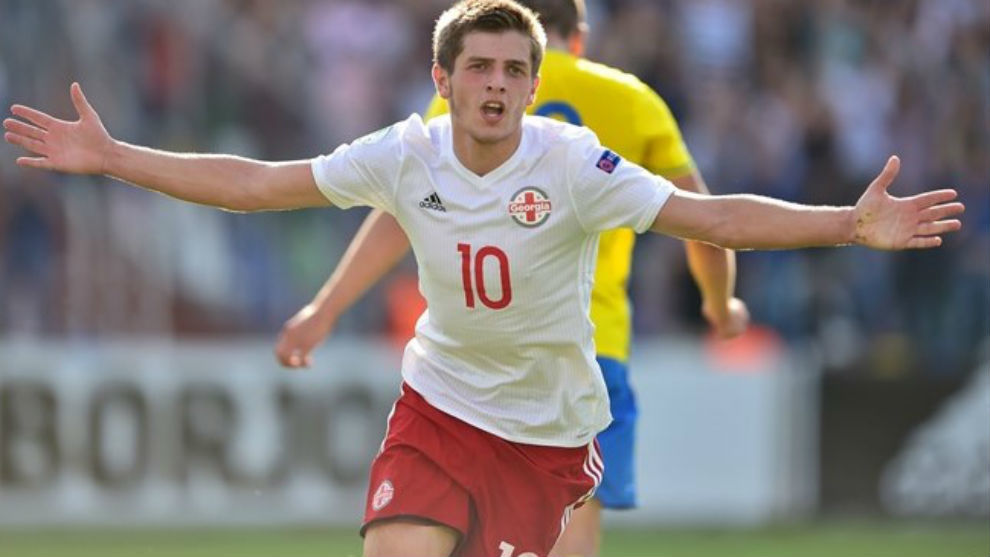
Image result for giorgi chakvetadze

DOB: 29/9/1999 (20)

Nationality: Georgia

Position: Attacking Midfielder

Club: KAA Gent

Tactical:

Chakvetadze has not featured that prominently this season due to a long-term injury, just recently coming back and making a few appearances off the bench so far this season, but in the 2018/19 season, Chakvetadze was a regular starter under first Yves Vanderhaeghe and then Jess Thorup. Under Thorup, Chakvetadze is normally deployed off the left of a 4-3-3 formation, but was also occasionally plays through the middle of a 4-2-3-1. Chakvetadze doesn’t play as a prototypical winger who would stay closer to the touchline before crossing at the byline or cutting inside at the last minute, but he plays more like a #10 who is forced to play out wide. Chakvetadze likes to play further inside and receive the ball at his feet so he can pick out a teammate or try to dribble around opposition, which also gives his left back the opportunity to make overlapping runs, but he will stay wide if needed too. On dead ball situations, Chakvetadze likes to stay outside the radius of the wall, usually on the edge of box or just inside the box to either the left or right of the wall. In regards to corners, he is usually the one to take the corners for Gent.

Technical:

Technically, Chakvetadze is a player who excels in certain aspects of his game, but also could use some work in other aspects. Playing out wide I feel does not give Chakvetadze the best platform to showcase his technical qualities, as I feel he is not best at trying to dribble past opponents on the wings, but rather has more quality when he is on the ball in the center of the park. While Chakvetadze does have the ability to dribble past opponents at times, he does get the ball trapped at his feet occasionally while trying to dribble past opponents, and also gets dispossessed easily at times when trying to take opponents on 1v1 on the wing. However, when he has the ability to play further inside and play with the ball more at his feet than receive the ball and try to dribble past, he excels. I have noticed in many matches where Chakvetadze ends up playing more inside and the left back will move up into a more wingback role, which frees Chakvetadze to play in his more favored #10 or even #8 role. He will drop deep to receive the ball if needed to, and has a tremendous work rate, as does the entire Gent team that he plays in.

Chakvetadze is a very good passer of the ball, which further solidifies the point of him excelling in a more central role than out wide. His pass accuracy usually hovers between 75-85% over the whole season, and he has a very good eye for runs that his teammates are making in behind the lines. He will also make line-breaking runs himself, but his innate ability to pick out his opponents with balls over the top or through the lines of the opponents is one of his strong suits. He also has a decent shot as well, but this is one aspect of his game that he needs to work on if he wants to become a more complete player as he matures. Another thing that he does is sometimes hold onto the ball for too long, and this usually is the case when he is making a run at the opposition. While he excels at picking out teammates, he also will sometimes have lapses in concentration, resulting in him losing possession too easily or picking the wrong pass.

Physical:

Chakvetadze stands at 6 ft tall which does make him on the taller side for a #10 or even a winger, but this height gives him some much needed physicality on the ball and off of it as well. Despite being taller, he does not do well in aerial duels, winning less than half of the aerial duels that he attempts. However, he does excel more in his normal 1v1 duels to win back possession, and he is not afraid to go shoulder to shoulder with a defender to try and win back possession. In regards to his quickness, Chakvetadze is not the quickest player in a straight line, and he will usually get caught by fullbacks when playing out on the wing. When playing inside, Chakvetadze instead uses his eyes to try and move his opponents to open up passing lanes, but he does occasionally use some of his pace to burst past opponents into the space. He also has a tremendous work rate, and usually will track back to help in defense whether he is playing as a #10 or out wide. Injuries could be a problem, with him missing almost all of the 2019/20 season with a knee injury that he picked up at the end of the 2018/19 season.

Summary:

With his injury that has cost him almost all of the 2019/20 season, Chakvetadze’s name has not been thrown around this season by any of the world’s biggest clubs. Compare that to the 2018/19 season where Chakvetadze had been rumored to have the interest of some of the world’s biggest clubs, with FC Barcelona one of the clubs rumored to have been chasing his signature. Giorgi Chakvetadze is definitely a very good young talent, but is probably second best in the Gent team because of the presence of Jonathan David. If Chakvetadze had not gotten injured and played a very crucial part in Gent’s season this term, then I would not be surprised if was poached by one of Europe’s biggest clubs this summer. However, with the injury and still being only 20 years of age, another season at full fitness in Gent’s side will do him very well in attracting some of the world’s biggest clubs again. I do feel that Giorgi Chakvetadze still has a very bright future as one of the best young prospects in world football, and I feel that he will still be a success at one of the world’s biggest clubs, he just has to wait his chance.